

Last week we announced that we are tokenizing robotaxis. The first question everyone asked: what does one actually earn?
So we did the math.
The Market
Per a recent report by Goldman Sachs, the global robotaxi market is projected to reach approximately $415 billion in 2035, with the US portion estimated at $48 billion that same year.
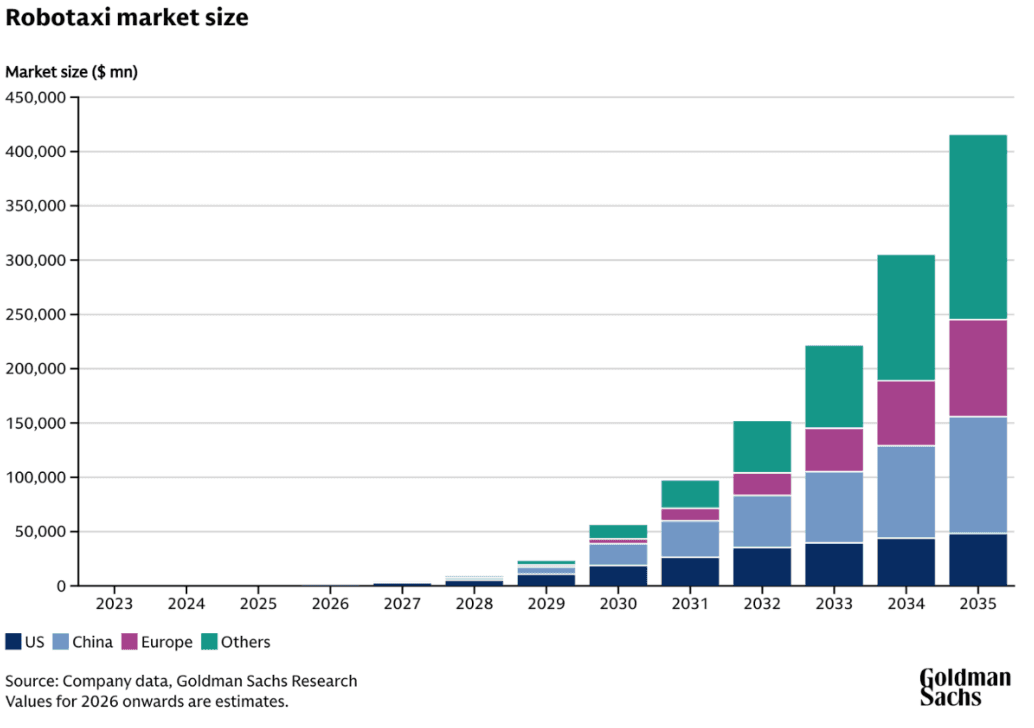
Goldman Sachs Research, April 30, 2026
ARK Invest thinks Tesla’s Cybercab will run at about half Waymo’s cost per mile, low enough to price rides as low as $0.25 a mile, less than a tenth of what a human driven ride costs today. ARK sees robotaxi platforms worth around $34 trillion by 2030.
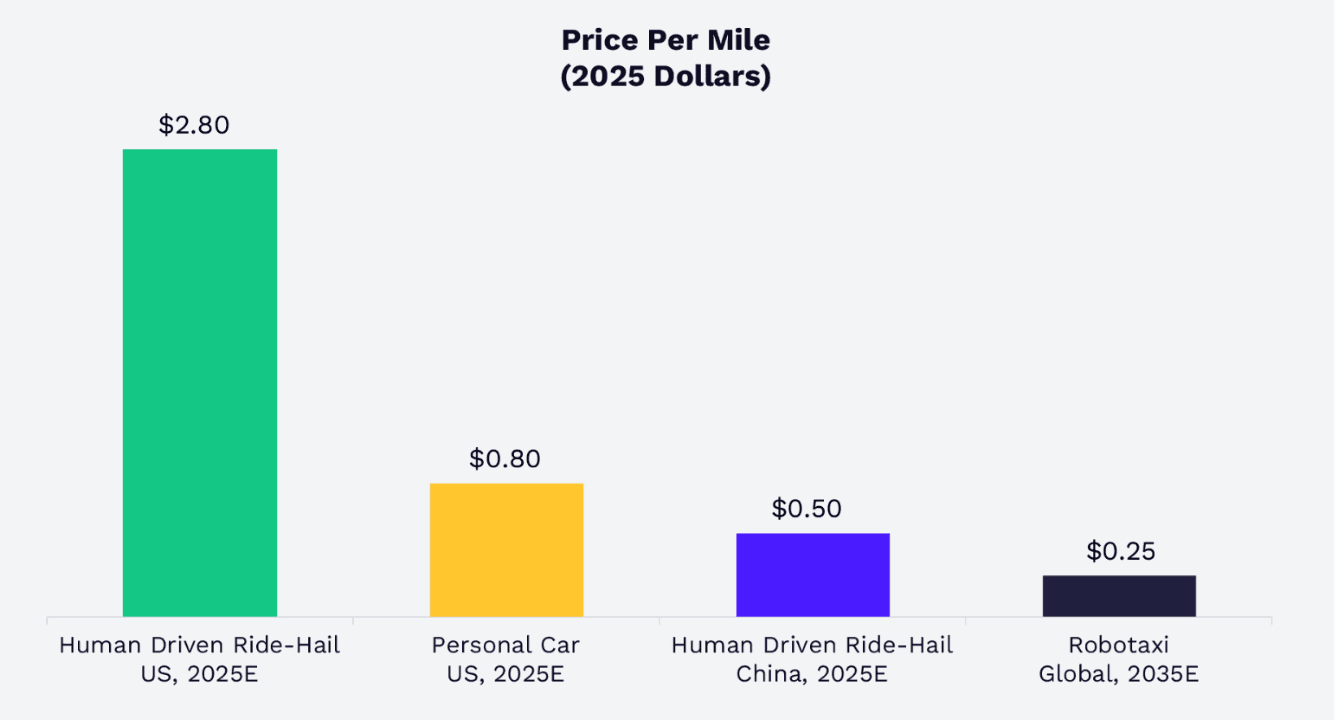
ARK Invest, February 2, 2026. Prices in 2025 dollars.
Regardless of which forecast you think is closer to the truth, someone will have to finance and run millions of these cars in the next decade.
We think Tesla’s Cybercab will have the best unit economics at scale. We’re not the only ones. Chamath has said he plans to buy and deploy large fleets and expects them to generate positive free cash flow in under two years.
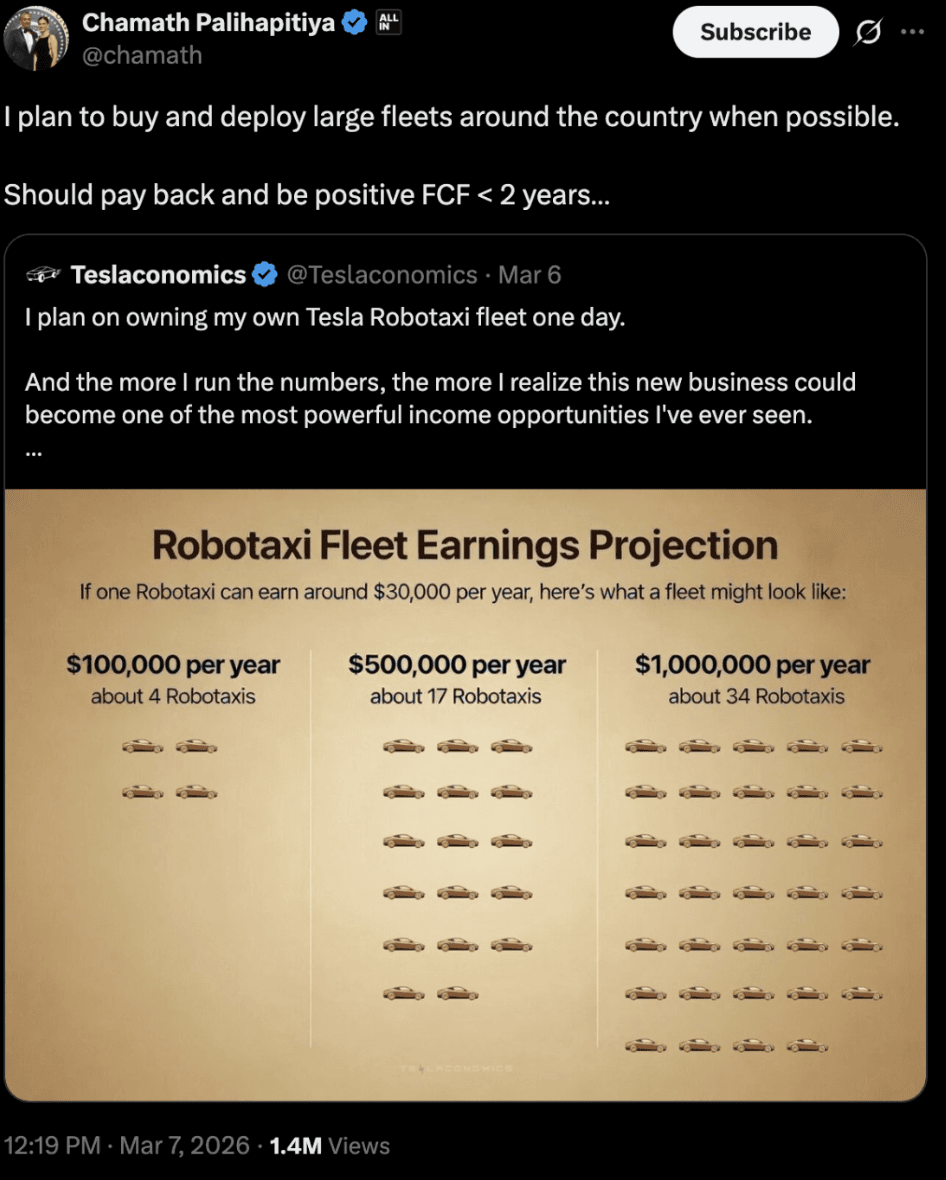
Chamath Palihapitiya on X, March 7, 2026
The Math on One Car
Nobody has published an official Tesla fleet contract yet, and Cybercabs aren’t available to buy. But we’ve spoken with several fleet operators about what it costs to run a fleet today, and our cost estimates are based on those conversations. Rides, fares, and Tesla’s fee are still our best estimates and can change over time.
Here are the key inputs behind our math: robotaxi price, rides per day, average fare price, assumed Tesla’s Robotaxi network fee, insurance, storage, and maintenance costs. (Definitions for each of these can be found at the bottom of the article.)
Here’s how it adds up for one car in our base case:
Start with a Cybercab at about $30,000.
It does 20 rides a day. (Roughly what a Waymo car averages today and about what a busy full-time Uber driver does in a full shift.)
At around $7 a ride, over 350 days a year, we reach around $49,000 in fares.
Tesla’s network keeps a share of every fare. We assume 30%, which leaves about $34,000.
Depot and operations (cleaning, maintenance, parking, charging, and a local operator) come to about $10,900.
We estimate insurance to be about $7,200 a year.
Leaving around $16,000 a year per car.
At that pace, a $30,000 car pays for itself in about 22 months.
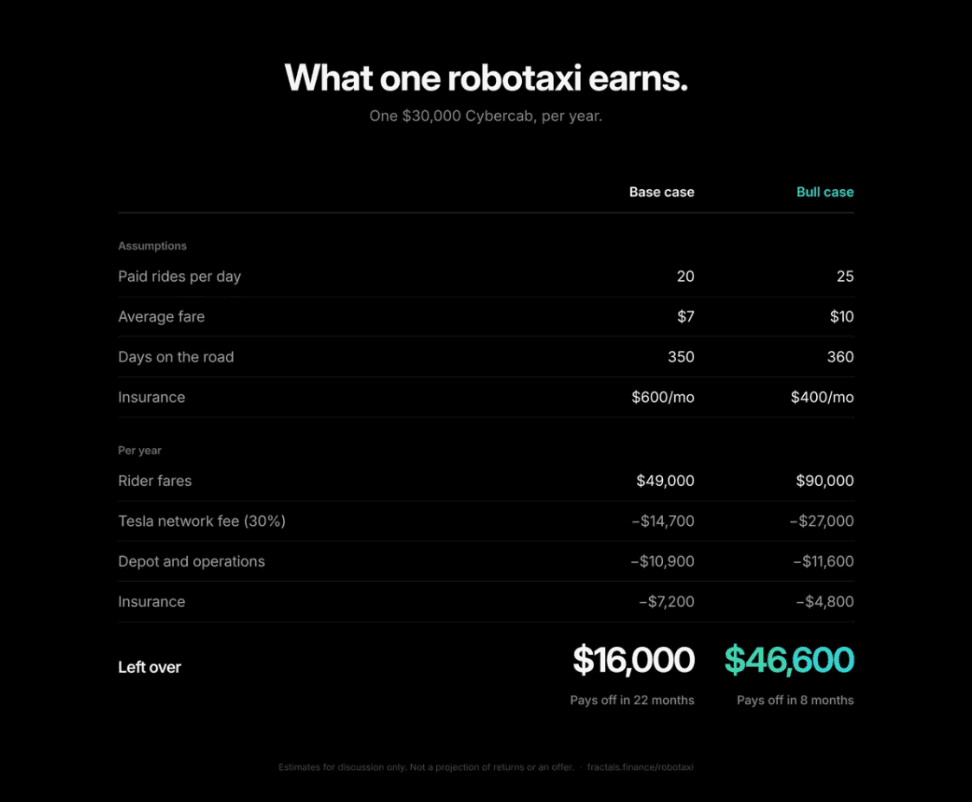
Team model. Base and bull cases, rounded.
Note: the worked example is our base case, and it rests on a lot of assumptions. As fleets scale, costs like insurance and depot operation should come down. We have shown this in our calculator. Fares may come down too, and paid rides per day may go up as AVs take over the rideshare market.
Where all these assumptions land is what decides what a robotaxi really earns, so we built a calculator to let you run the numbers yourself.
fractals.finance/robotaxi/calculator
Share your results!
Glossary
Car price: what it costs to buy one Cybercab.
Paid rides per day: how many trips one car completes with a rider on board. It’s the biggest lever in the model, because a car that sits idle earns nothing.
Average fare: what a rider pays for one trip.
Tesla network fee: the share of each fare Tesla keeps for running the ride network, including the app, dispatch, and self-driving software.
Days on the road: how many days a year the car is out earning, after time off for repairs, recalls, and bad weather.
Average trip: the typical distance of one paid ride.
Insurance: commercial coverage for a driverless car.
Depot and operations: everything it takes to keep a car charged, clean, and on the road, usually handled by a local operator at a depot. That covers charging, maintenance, cleaning, a parking and charging spot, and the operator’s fee.
Sources
01 Goldman Sachs Research: Robotaxis forecast to become a $400 billion market in 2035 April 30, 2026
02 ARK Invest: Tesla discloses robotaxi roadmap for 2026 February 2, 2026
03 Chamath Palihapitiya on X: Robotaxi fleet payback March 7, 2026
04 Not a Tesla App: Tesla Robotaxi pricing in Austin
05 Claims Journal: Waymo’s path to 1 million weekly trips
06 Gridwise: How much Uber drivers make in 2026
07 Basenor: Cybercab target price and battery
The people will own the machines.